
Introduction
World Wide Workshop
The following information is taken directly from the World Wide Workshop's About page and can be accessed by clicking here.
1. Workshop Mission
World Wide Workshop develops applications for learning with technology that combine game mechanics and social networking to empower youth to be inventors and leaders in the global knowledge economy. Our programs transform education by connecting youth to learning, community engagement and economic development through game production.
The Workshop is proud to respond to President Obama’s call to action: Educate to Innovate and Change the Equation in STEM Education. Committed to improving quality education opportunities for all youth in USA and the world, we work with forward-thinking leaders, corporations, school systems, universities, and research centers to enrich existing formal and non-formal education systems with the latest technology and innovative learning opportunities.
President Obama calls on every American to learn code: "Don't just buy a new video game – make one. Don't just download the latest app – help design it. Don't just plan on your phone – program it."
2. Non-Discrimination Policy:
World Wide Workshop does not exclude, deny benefits to, or otherwise discriminate against any person on the ground of race, color, national origin, age, sex, religion or disability in admission to, participation in, or receipt of the services and benefits of any of its programs and activities or in employment therein, whether carried out by World Wide Workshop directly or through a contractor or any other entity with whom the World Wide Workshop arranges to carry out its programs and activities.
3. Problems Addressed: Closing the Digital Literacy Gap Today, rural and poor communities throughout the nation face tough challenges in education and economic development. Compounding these challenges is limited access to technological innovations and advances. As the world rockets forward into a so-called "knowledge economy," poor and underserved communities encounter two digital divides.
The first divide is defined by access or lack of access to high-speed Internet. The second divide is defined by digital literacy-that is, the ability to create, not just consume, digital media. Digital literacy enables true participation in the power and potential of the new Internet.
In 2006, the World Wide Workshop established the Globaloria program to help close the digital literacy gaps that exist in the United States and worldwide.
4. Philosophy: Learning-by-Doing for Real-World Application
Our programs are based on Constructionist educational philosophy, grounded in decades of research by social scientists Seymour Papert and (World Wide Workshop founder) Idit Harel Caperton. Unlike top-down teaching styles requiring memorization of facts, Constructionism calls for the creation of public digital entities. Through publicly shared, long-term projects that are complex, computational, immersive, and innovative, children learn how to learn and how to think about thinking. Online open workshop settings facilitate syntonic learning - or learning by doing. Twenty years of research have shown that constructivist programs result in deeper forms of learning, cognitive integration, and improved approaches to learning how to learn.
Our programs are unique among educational digital literacy initiatives in that they are the first to delineate and prioritize the most complex constructionist activities.
5. Innovation: Using Social Media Technologies and Gaming for Educational Transformation Interactive digital communication increasingly defines the way our world works. It's the way businesses operate, the way we access services, the way we are entertained, and the way we participate as citizens locally, nationally, and globally. Understanding digital communication tools and putting them to work effectively - achieving digital literacy - is essential for success in the 21st Century.
We must teach young learners to read and construct their own interactive digital media systems: textual and graphical media, photography and video media, animation and game media, and more. Blogs, wikis, and social network platforms, utilized in a new educational paradigm, encourage young people to imagine, create, process, and share ideas and expertise as they create artifacts and tell stories.
The World Wide Workshop is the first organization to create a program that does all this, teaching proficiency in both the "new writing" together/combined with the new formula of participatory, collaborative project-based learning. The program is Globaloria, and it achieves its educational purpose by empowering young learners to engage in social and collaborative game construction using open-source Web 2.0 platforms. Globaloria is where social networks and gaming meet social responsibility and education. It is 21st century literacy for 21st century success.
6. Impact: Contemporary Learning Abilities
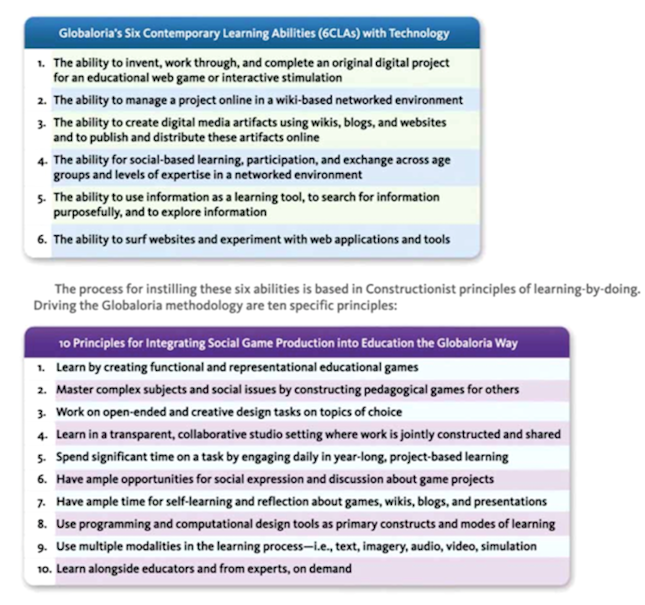
Through construction, interaction and play our programs empower youth with the highly sophisticated and complex skills required to be productive, successful, 21st Century citizens; what we call the essential contemporary learning abilities inherent in digital literacy:
Globaloria's Six Contemporary Learning Abilities with Technology
7. Research: Assessing our impact
World Wide Workshop researchers use a variety of methods to evaluate the cognitive, behavioral, and affective impact of our programs. Researchers implement a complex and eclectic methodology, which they consider to be a pilot in and of itself, including the use of:
Data on the programs and the assessment methods inform real-team program enhancements and refinements on an ongoing basis. Our research reports are available upon request. A list of our research partners is located here.
8. Standards-Aligned Curriculum
Globaloria is a standards-aligned STEM and computing curriculum delivered through an innovative blended-learning system. Globaloria is aligned with:
9. Meet Our Team
The Workshop is proud to respond to President Obama’s call to action: Educate to Innovate and Change the Equation in STEM Education. Committed to improving quality education opportunities for all youth in USA and the world, we work with forward-thinking leaders, corporations, school systems, universities, and research centers to enrich existing formal and non-formal education systems with the latest technology and innovative learning opportunities.
President Obama calls on every American to learn code: "Don't just buy a new video game – make one. Don't just download the latest app – help design it. Don't just plan on your phone – program it."
2. Non-Discrimination Policy:
World Wide Workshop does not exclude, deny benefits to, or otherwise discriminate against any person on the ground of race, color, national origin, age, sex, religion or disability in admission to, participation in, or receipt of the services and benefits of any of its programs and activities or in employment therein, whether carried out by World Wide Workshop directly or through a contractor or any other entity with whom the World Wide Workshop arranges to carry out its programs and activities.
3. Problems Addressed: Closing the Digital Literacy Gap Today, rural and poor communities throughout the nation face tough challenges in education and economic development. Compounding these challenges is limited access to technological innovations and advances. As the world rockets forward into a so-called "knowledge economy," poor and underserved communities encounter two digital divides.
The first divide is defined by access or lack of access to high-speed Internet. The second divide is defined by digital literacy-that is, the ability to create, not just consume, digital media. Digital literacy enables true participation in the power and potential of the new Internet.
In 2006, the World Wide Workshop established the Globaloria program to help close the digital literacy gaps that exist in the United States and worldwide.
4. Philosophy: Learning-by-Doing for Real-World Application
Our programs are based on Constructionist educational philosophy, grounded in decades of research by social scientists Seymour Papert and (World Wide Workshop founder) Idit Harel Caperton. Unlike top-down teaching styles requiring memorization of facts, Constructionism calls for the creation of public digital entities. Through publicly shared, long-term projects that are complex, computational, immersive, and innovative, children learn how to learn and how to think about thinking. Online open workshop settings facilitate syntonic learning - or learning by doing. Twenty years of research have shown that constructivist programs result in deeper forms of learning, cognitive integration, and improved approaches to learning how to learn.
Our programs are unique among educational digital literacy initiatives in that they are the first to delineate and prioritize the most complex constructionist activities.
5. Innovation: Using Social Media Technologies and Gaming for Educational Transformation Interactive digital communication increasingly defines the way our world works. It's the way businesses operate, the way we access services, the way we are entertained, and the way we participate as citizens locally, nationally, and globally. Understanding digital communication tools and putting them to work effectively - achieving digital literacy - is essential for success in the 21st Century.
We must teach young learners to read and construct their own interactive digital media systems: textual and graphical media, photography and video media, animation and game media, and more. Blogs, wikis, and social network platforms, utilized in a new educational paradigm, encourage young people to imagine, create, process, and share ideas and expertise as they create artifacts and tell stories.
The World Wide Workshop is the first organization to create a program that does all this, teaching proficiency in both the "new writing" together/combined with the new formula of participatory, collaborative project-based learning. The program is Globaloria, and it achieves its educational purpose by empowering young learners to engage in social and collaborative game construction using open-source Web 2.0 platforms. Globaloria is where social networks and gaming meet social responsibility and education. It is 21st century literacy for 21st century success.
6. Impact: Contemporary Learning Abilities
Through construction, interaction and play our programs empower youth with the highly sophisticated and complex skills required to be productive, successful, 21st Century citizens; what we call the essential contemporary learning abilities inherent in digital literacy:
Globaloria's Six Contemporary Learning Abilities with Technology
- Invention, progression, and completion of an original digital project idea (for an educational web- game or interactive simulation)
- Project-based learning through online project management in a wiki-based networked environment
- Publishing and distribution of self-created digital media
- Social-based learning, participation and exchange in a networked environment
- Information- based learning, purposeful search, exploration
- Surfing websites and web applications
7. Research: Assessing our impact
World Wide Workshop researchers use a variety of methods to evaluate the cognitive, behavioral, and affective impact of our programs. Researchers implement a complex and eclectic methodology, which they consider to be a pilot in and of itself, including the use of:
- Pre- and post- program surveys
- Real-time statistical and empirical tracking of activities and behaviors
- Case studies
- Evaluations of work product
- Evaluations of wiki participation
- Interviews, conference calls, and email exchanges with educators
- In-person visits
- Videos and transcriptions from site visits
Data on the programs and the assessment methods inform real-team program enhancements and refinements on an ongoing basis. Our research reports are available upon request. A list of our research partners is located here.
8. Standards-Aligned Curriculum
Globaloria is a standards-aligned STEM and computing curriculum delivered through an innovative blended-learning system. Globaloria is aligned with:
- ISTE National Educational Technology Standards
- Common Core State Standards
- Computer Science Teachers Associations Standards
- Next Generation Science Standards
- State Standards
9. Meet Our Team
Next Billion Learners
 This program focuses on the development of creative learning software for low cost laptops, in order to support 1:1 computing worldwide. Their goal is to give educational opportunities to the next billion learners so that they will become creative thinkers, learners and leaders with technology. One of the Next Billion Learners' projects was a collaboration with One Laptop Per Child (OLPC), where they created the MaMaMedia Creative Center, a set of original Constructionist learning activities for young children in developing countries.
 |
| One Laptop per Child : Zimi's Story FULL - Video Dailymotion |
Interviews
 |
Idit Harel Caperton on Video Games as the New Language Arts, Interview by Paul Glader of WiredAcademic, December 14, 2011

Honors & Awards
Children Designers: Through her study at the Harvard Graduate School of Education and the MIT Media Lab, Harel Caperton established the children as software designers method of learning. She studied the Constructionist vision of computer programming and in 1991 wrote her book Children Designers, which casted learners in the role of instructors and knowledge communicators rather than information recipients, and in the role of media producers rather than consumers.

*2013: Globaloria awarded Silicon Valley Education Foundation STEM Innovation Award in the Science Category
*2013: Globaloria named Microsoft Education Laureate in The Tech Museum of Innovation Tech Awards
*2013: Named to Disruptor Foundation Fellows
*2011: Named “Digital Leader and Luminary” by Digital Learning Now!
*2010: Jessie McCanse Award for Individual Contribution to Media Literacy, by the National Telemedia Council.
*2005: Named Beijing Normal University Honorary Professor.
*2002: The Network of Educators in Science and Technology and MIT honored Dr. Idit Harel Caperton their “Award for devotion, innovation, and imagination in science and technology on behalf of children and youth around the world.”
*1991: Outstanding Book Award for Children Designers, by the American Education Research Association (AERA).
*1989: Journal of Mathematical Behavior - Special Annual Issue on Outstanding Dissertation: Interdisciplinary Constructions of Learning and Knowing Mathematics in a Computer-Rich School.
*2013: Globaloria awarded Silicon Valley Education Foundation STEM Innovation Award in the Science Category
*2013: Globaloria named Microsoft Education Laureate in The Tech Museum of Innovation Tech Awards
*2013: Named to Disruptor Foundation Fellows
*2011: Named “Digital Leader and Luminary” by Digital Learning Now!
*2010: Jessie McCanse Award for Individual Contribution to Media Literacy, by the National Telemedia Council.
*2005: Named Beijing Normal University Honorary Professor.
*2002: The Network of Educators in Science and Technology and MIT honored Dr. Idit Harel Caperton their “Award for devotion, innovation, and imagination in science and technology on behalf of children and youth around the world.”
*1991: Outstanding Book Award for Children Designers, by the American Education Research Association (AERA).
*1989: Journal of Mathematical Behavior - Special Annual Issue on Outstanding Dissertation: Interdisciplinary Constructions of Learning and Knowing Mathematics in a Computer-Rich School.
Globaloria
What Is Globaloria?

 Globaloria is a social learning system and educational program of the World Wide Workshop. It was first established in 2006 to advance technology-based educational opportunities for students in technologically under-served regions and communities. It sparks students' imaginations as they learn to design and program their own educational games through a mix of teacher-led instruction, team-based learning, and online networking with experts and peers.
 Globaloria Features:
- Customizable curriculum
- 360-degree learning system for students, teachers and principals
- STEM content and skill-building
- Professional development and mentoring
- Robust technical support
- Suitable for public, charter and independent schools

Rebecca Reynolds and Idit Harel Caperton describe in their social science and evaluation research on Globaloria that four primary spheres of engagement are occurring in Globaloria—inquiry, collaboration, digital content construction and knowledge-sharing—to inculcate student expertise and mastery within six key domains of digital learning (called the 6 Contemporary Learning Abilities).
MaMaMedia
MaMaMedia Inc., an Internet company, develops activity-based learning products for kids aged 12 and under, and their families. The company operates MaMaMedia.com, a Website that provides engaging activities for kids to gain technological fluency and expand their minds. It enables kids to design and animate characters, make their own digital cards, invent games, and more; and save, publish, and email their creations to friends. The company was founded in 1995 and is based in New York, New York. (Bloomberg Businessweek)
 Basing itself on the educational principles of Constructionism, the site provided web users with a range of "playful learning" activities and projects. It is the first web service to explicitly incorporate the concepts of educational theorists such as John Dewey (pictured), Jean Piaget, and Seymour Papert in its design.
How does World Wide Workshop describe their design?
On MaMaMedia.com children use the Internet to read and write, but also to become young designers, builders, artists and writers themselves. All the activities on the site were designed to provide media for children to create their own media, and to involve children directly in the design process, as children use tools to create and produce their own media, explore and express idea, and join a safe online community of kids. The design of MaMaMedia.com teaches children how to use browsers, various media tools, and Internet technologies - all for the high purpose of creating, building, and expressing themselves and learning about the world around them from other children and websites. The activities are designed for all types of browsers -- low-end and high-end, as well as for use in diverse environments, including home, school, a library or community center. The key design principle we embedded in all these activities was to invite children to think openly and creatively, collaborate effectively, overcome technological challenges, continuously generate new ideas - and have fun along the way! We believe these are some of the essential skills for success in closing the digital divide in the 21st century.
Basing itself on the educational principles of Constructionism, the site provided web users with a range of "playful learning" activities and projects. It is the first web service to explicitly incorporate the concepts of educational theorists such as John Dewey (pictured), Jean Piaget, and Seymour Papert in its design.How does World Wide Workshop describe their design?
On MaMaMedia.com children use the Internet to read and write, but also to become young designers, builders, artists and writers themselves. All the activities on the site were designed to provide media for children to create their own media, and to involve children directly in the design process, as children use tools to create and produce their own media, explore and express idea, and join a safe online community of kids. The design of MaMaMedia.com teaches children how to use browsers, various media tools, and Internet technologies - all for the high purpose of creating, building, and expressing themselves and learning about the world around them from other children and websites. The activities are designed for all types of browsers -- low-end and high-end, as well as for use in diverse environments, including home, school, a library or community center. The key design principle we embedded in all these activities was to invite children to think openly and creatively, collaborate effectively, overcome technological challenges, continuously generate new ideas - and have fun along the way! We believe these are some of the essential skills for success in closing the digital divide in the 21st century.
Subscribe to:
Posts (Atom)